
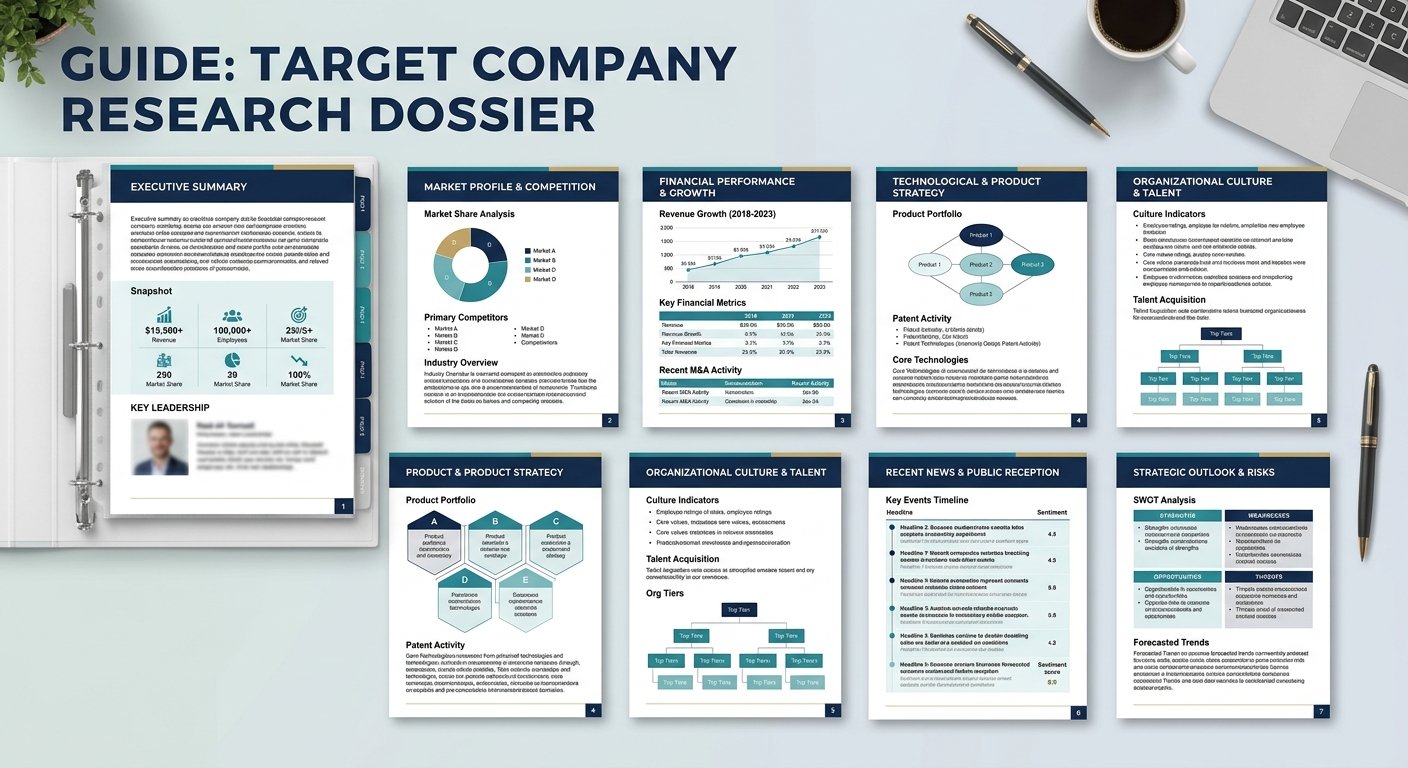
A research dossier for target company analysis is one of the most valuable documents you can build before a sales call, investment, partnership, or job interview. Instead of walking in with guesses, you walk in with facts, context, and a clear plan. Whether you are a business developer, an investor, a recruiter, or a freelancer chasing a big client, a strong dossier saves time and improves every decision that follows.
In this guide from KerChiller, you will learn what a dossier is, which sections it needs, where to find reliable data, and how to build one from scratch. You will also get a ready-to-use template and a list of mistakes to avoid.
What Is a Research Dossier for a Target Company?
A research dossier is a structured file that collects everything important about one specific organization in a single place. The word “dossier” comes from the idea of a complete record on a subject. When the subject is a company, the record covers its history, leadership, finances, products, customers, competitors, risks, and recent news.
A target company research dossier is different from a simple company profile. A profile describes who the company is. A dossier goes further and answers a practical question: what should I do with this information? It connects facts to your goal, whether that goal is closing a deal, making an investment, or landing a job.
Think of it as the difference between a brochure and a briefing. A brochure tells you what a company wants you to know. A briefing tells you what you actually need to know.
Why a Research Dossier Matters
Skipping research is expensive. Many failed sales pitches, bad investments, and awkward interviews share the same root cause: the person did not understand the company they were dealing with. A well-prepared dossier gives you several clear advantages.
- Better conversations: You can ask smart questions and speak to real problems instead of reading from a generic script.
- Faster decisions: When all the facts sit in one document, comparing options takes minutes instead of days.
- Lower risk: Early research exposes red flags such as lawsuits, declining revenue, or leadership turnover before you commit time or money.
- Stronger positioning: When you understand a company’s goals, you can show exactly how you help them reach those goals.
- Team alignment: A shared dossier keeps sales, marketing, and management working from the same facts.
Who Needs a Target Company Dossier?
Almost anyone who deals with organizations can benefit from this kind of research.
Sales and business development teams use dossiers to personalize outreach and find the right decision-makers. Investors and analysts use them for due diligence before putting money into a business. Recruiters and job seekers use them to prepare for interviews and judge company culture. Freelancers and agencies use them to pitch services that match a client’s real needs. Journalists and researchers use them to verify claims and build background for stories.
The structure is similar for everyone. Only the emphasis changes. A salesperson cares most about pain points and budget, while an investor focuses on financial health and growth.
Key Components of a Research Dossier
A complete dossier has several core sections. You do not need every section for every project, but knowing the full list helps you decide what matters.
1. Company Overview
Start with the basics: legal name, founding year, headquarters, number of employees, ownership structure, and mission statement. Note whether the company is private, public, or a subsidiary. This section gives your reader the big picture in under a minute.
2. Leadership and Key People
List the CEO, founders, board members, and department heads relevant to your goal. Record their backgrounds, previous companies, and public statements. For sales research, identify who owns the budget and who influences the buying decision. Professional networking profiles and company “About” pages are useful starting points.
3. Financial Health
Financial data shows whether a company is growing, stable, or struggling. For public companies, look at revenue, profit margins, debt, and cash flow over several years. For private companies, use funding rounds, investor names, and estimated revenue ranges. Always note the date of each figure, because old numbers can mislead.
4. Products, Services, and Business Model
Explain what the company sells, who buys it, and how it makes money. Is revenue based on subscriptions, one-time sales, licensing, or advertising? Understanding the business model helps you predict what the company values and where it may be vulnerable.
5. Market Position and Competitors
No company exists alone. Identify the top three to five competitors, compare their strengths, and note where your target stands in the market. A simple SWOT analysis (strengths, weaknesses, opportunities, threats) works well here and keeps the section easy to scan.
6. Technology and Operations
For tech-driven businesses, review the tools and platforms they use, their website performance, and their hiring patterns. Job postings are a goldmine, since a company hiring ten data engineers is clearly investing in data. This section is especially useful for software vendors and IT service providers.
7. News, Sentiment, and Recent Events
Collect recent press releases, media coverage, product launches, partnerships, and customer reviews. Pay attention to negative stories as well as positive ones. A recent acquisition or leadership change can completely change how you approach the company.
8. Risks, Legal Issues, and Compliance
Check for lawsuits, regulatory fines, data breaches, and public complaints. This section protects you from nasty surprises. Even a small risk should be recorded, along with its source and date.
9. Opportunities and Action Plan
This is what turns a report into a true dossier. End with a short summary of the best opportunities and your recommended next steps. Include the key talking points, the right contact person, and the ideal timing for outreach.
How to Build a Research Dossier for a Target Company: Step by Step
Follow this simple process to create a professional dossier in a few hours.
Step 1: Define your goal. Write one sentence explaining why you are researching this company. “Win a contract for web development services” leads to very different research than “Decide whether to invest.”
Step 2: Collect basic facts. Visit the company’s website, social profiles, and press page. Record the overview details listed above.
Step 3: Dig into official records. For public companies in the United States, the SEC EDGAR database offers free access to annual reports, quarterly filings, and ownership disclosures. These documents are far more reliable than blog summaries.
Step 4: Study the people. Review the leadership team and decision-makers. Note shared interests, past achievements, and the topics they discuss publicly.
Step 5: Analyze the competition. Compare the company against its rivals on price, features, reputation, and market share.
Step 6: Scan news and reviews. Search for the company name plus words like “lawsuit,” “layoffs,” “funding,” or “partnership.” Read customer reviews to find recurring complaints.
Step 7: Organize everything clearly. Use headings, short paragraphs, and tables. A dossier nobody can read quickly is a dossier nobody will use.
Step 8: Add insights and recommendations. Do not just list facts. Explain what each finding means for your goal.
Step 9: Review and update. Check every claim against its source, then set a reminder to refresh the document. Companies change fast, and a six-month-old dossier may already be outdated.
Best Sources and Tools for Company Research
Good research depends on good sources. Mix free and paid options based on your budget.
- Official company websites and blogs: best for mission, products, and announcements
- Government filings: SEC EDGAR, company registries, and patent databases for verified data
- News search and alerts: set alerts for the company name to track updates
- Professional networks: useful for leadership, team size, and hiring trends
- Review platforms: show customer and employee opinions
- Business databases: paid tools such as Crunchbase, PitchBook, or ZoomInfo offer funding and contact data
- Social media: reveals tone, audience engagement, and brand image
Always cross-check important numbers in at least two places. If two sources disagree, trust the official filing and note the difference.
Simple Research Dossier Template
Copy this outline into a document or spreadsheet and fill it in for each company:
- Company snapshot: name, industry, size, location, website
- Leadership: names, titles, backgrounds
- Financials: revenue, growth rate, funding, profitability
- Offerings: products, pricing, customers
- Competitors: top five and key differences
- Recent news: last six months of important events
- Risks: legal, financial, reputational
- Opportunities: where you can add value
- Action plan: next steps, contact person, timeline
- Sources and date: links and last-updated date
Keep the whole dossier between two and ten pages. Anything longer should include a one-page executive summary at the top.
Common Mistakes to Avoid
Even experienced researchers make errors that weaken their dossiers.
- Collecting without a goal: more data does not mean better insight. Stay focused on your purpose.
- Trusting outdated information: always check dates, especially on financial figures.
- Relying on one source: a single biased article can distort the whole picture.
- Ignoring negative news: red flags matter more than success stories.
- Copying without analysis: a pile of facts is not a dossier. Add your own conclusions.
- Forgetting to cite sources: without links, nobody can verify your claims.
- Never updating: treat the dossier as a living document.
Ethical and Legal Considerations
Good research stays on the right side of the law. Use only publicly available and legitimately obtained information. Do not access private accounts, use deceptive tactics to get internal data, or collect sensitive personal details about individuals. Follow data protection rules such as GDPR where they apply, and respect copyright when quoting sources. Ethical research also builds trust, which makes your later outreach more effective.
Final Thoughts
A well-built research dossier for target company projects turns confusion into clarity. It helps you understand who you are dealing with, what they need, and how to approach them with confidence. Start with a clear goal, gather reliable data from trusted sources, organize it simply, and finish with actionable recommendations. Update it regularly, and it will become one of the most useful tools in your business toolkit.
Need help with a business research topic, or want us to cover a specific subject? Feel free to contact our team and share your ideas.
Frequently Asked Questions
How long should a research dossier be?
Most dossiers run two to ten pages. Add a one-page summary at the top if the document is longer.
How long does it take to create one?
A basic dossier takes two to four hours. A deep investment-grade report can take several days.
Can I make a dossier for a private company?
Yes. Use funding announcements, press coverage, job listings, customer reviews, and business databases, since private companies publish fewer financial details.
Is a dossier the same as a SWOT analysis?
No. A SWOT analysis is just one section inside a full dossier.
How often should I update it?
Review it before every major meeting or decision, and refresh it at least every three to six months.
2 thoughts on “Research Dossier for Target Company: A Complete Step-by-Step Guide”