
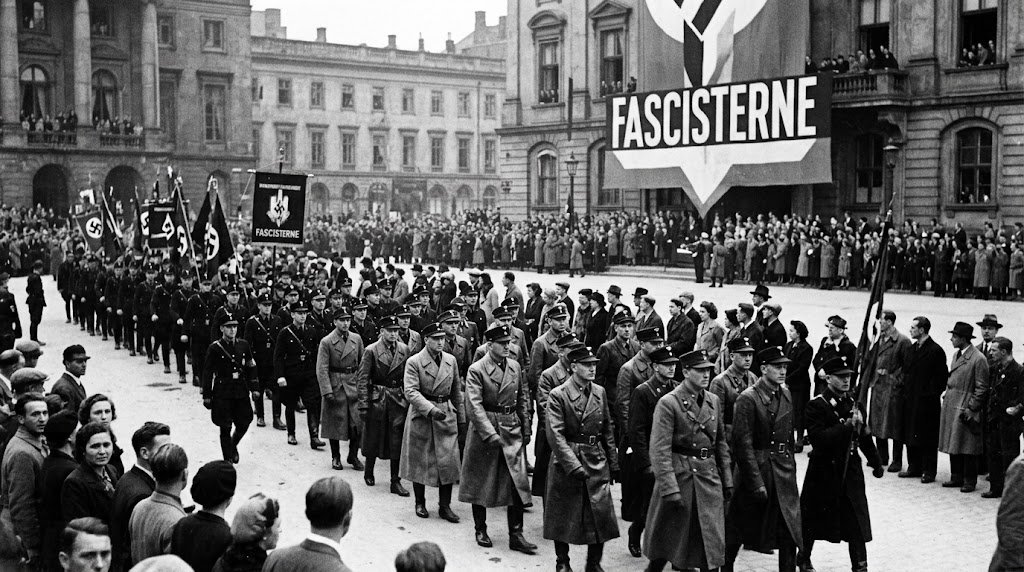
If you have landed here after searching for “fascisterne,” you have probably run into a word that looks like a name, a movement, or a brand. It is none of those. Fascisterne is Danish for “the fascists,” built from the noun fascist and the Danish definite plural ending -erne. In English, you would simply say “the fascists.”
Many websites treat the word as if it were a proper noun, which creates confusion. This guide clears that up. It explains what the term means, where fascism came from, what defines it, how it spread beyond Italy, and why historians still study it closely today. The goal is a clear, factual overview that you can rely on.
What Does “Fascisterne” Mean?
In Danish, fascisterne refers to the followers, members, or supporters of fascism. The singular form is fascist, the plural is fascister, and the definite plural (the fascists) is fascisterne. Danish reference works use the word when describing Mussolini’s movement in Italy and similar groups elsewhere.
Fascism itself is a political movement and ideology. Scholars usually describe it as far-right, authoritarian, and ultranationalist, with a strong leader at the center and little tolerance for opposition. Because definitions vary, historians still debate exactly which regimes and movements qualify, but the Italian case is the starting point for almost every discussion.
Where the Word Comes From
The term goes back to ancient Rome. The Latin word fasces described a bundle of wooden rods, often tied around an axe, carried before Roman officials as a sign of authority. The Italian word fascio means bundle or group, and it gave the movement its name.
Danish encyclopedia entries trace fascisme to the Italian fascismo, which in turn comes from fascio. The imagery stuck. The bundle of rods suggested strength through unity, which is exactly the message the movement wanted to project.
Origins: Italy, 1919 to 1922
Fascism was founded by Benito Mussolini in Milan on 23 March 1919. His first groups were called fasci di combattimento, or combat leagues, and they drew heavily on First World War veterans. Early fascists presented themselves as nationalist, anti-socialist, and openly hostile to parliamentary democracy. They also used violence as a political tool against rivals.
Italy at the time was struggling. The country had come out of the war with heavy losses, high unemployment, rising prices, and widespread strikes. Many people felt that the government had failed them and that the peace settlement had cheated Italy. That mood gave the fascists an opening.
The turning point came in October 1922. Fascist forces staged the March on Rome, a show of force that pressured the king into inviting Mussolini to form a government. Mussolini did not personally lead the march, but he ended up as prime minister anyway. Over the next few years, especially from 1925, the fascists gradually took over the state, silenced opponents, and turned a parliamentary system into a dictatorship.
Key Characteristics of Fascism
There is no single checklist that every scholar accepts, but several features appear again and again in historical studies.
- Extreme nationalism. The nation is treated as the highest value, often with a myth of past glory that must be restored.
- A single leader. Power is concentrated in one figure, whose authority is presented as beyond question.
- Rejection of democracy and pluralism. Free elections, independent courts, and open debate are treated as weaknesses.
- Cult of violence and militarism. Force is celebrated, and uniformed party organizations are common.
- Suppression of opposition. Rival parties, unions, and independent media are banned, absorbed, or intimidated.
- Propaganda and mass mobilization. Rallies, slogans, and controlled media build loyalty and emotional intensity.
- Scapegoating. Minorities, foreigners, or political enemies are blamed for national problems.
The Italian writer and scholar Umberto Eco argued in a well-known 1995 essay that fascism has no clean, single definition. Instead, he described a cluster of habits and features that can appear in different combinations. That idea is useful, because it explains why historians compare movements carefully rather than applying the label casually.
Did Fascism Create a Fully Totalitarian State in Italy?
This is a point that often gets lost. Danish and international historians note that Mussolini’s Italy was authoritarian and repressive, yet it never became as completely controlled as Nazi Germany or the Soviet Union. The monarchy remained in place, the Catholic Church kept its independence, and parts of the economy and society stayed outside direct party control.
That nuance does not make the regime mild. Italy invaded Ethiopia in 1935, introduced racial laws in 1938, and joined Germany in the Pact of Steel in 1939. It simply means that precise language matters when describing how the system worked.
How Fascism Spread Beyond Italy
Italian fascism inspired imitators across Europe. The most infamous was Nazi Germany, which took power in 1933. Although German National Socialism had its own ideas, especially its racial ideology, Nazi leaders openly admired and borrowed from Mussolini in the early years. Other examples include Franco’s Spain, the Iron Guard in Romania, and the Arrow Cross in Hungary.
Each case had local roots, which is why scholars speak of “fascisms” as much as one fascism. Denmark offers a useful example. The Danish National Socialist Workers’ Party, known as DNSAP, was founded in 1930 and remained a small fringe movement. Even during the German occupation, when it had every advantage, it won only about 2 percent of the vote in the 1943 election. Danish society’s strong democratic traditions, trade unions, and cooperative movements left little room for authoritarian extremes.
Why People Were Drawn to Fascism
Understanding fascism does not mean excusing it. It means asking why it worked for a time. Historians point to a recurring mix of conditions:
- Economic crisis. Mass unemployment and inflation made ordinary people desperate.
- Fear of revolution. Middle-class and business groups worried about communist uprisings.
- Weak or divided governments. Parliaments seemed unable to solve urgent problems.
- Wounded national pride. Defeat or disappointing peace deals created resentment.
- Charismatic promises. Fascist leaders offered simple answers, order, and a sense of belonging.
None of these conditions guarantees the rise of fascism, but together they help explain why certain countries slid toward dictatorship while others held firm.
Collapse and Aftermath
Fascist Italy did not survive the Second World War. After Allied forces landed in Sicily in 1943, Mussolini was removed from power by the Fascist Grand Council. A German-backed puppet state in northern Italy held on for a time, but the regime was finished by 1945, and Mussolini was killed by Italian partisans.
The war ended in total defeat for the fascist powers, and the cost was enormous. In the decades since, postwar Europe built institutions meant to prevent a repeat, including constitutional protections for human rights, stronger courts, and international cooperation.
Common Misconceptions About “Fascisterne”
“It is the name of a group.” In Danish it is simply a plural noun, not an organization.
“Any authoritarian regime is fascist.” Not necessarily. Many dictatorships have different ideologies and structures, and scholars use the word carefully.
“Fascism is only history.” The movement as a governing force ended in the 1940s, but its tactics, such as scapegoating and the glorification of a single leader, still attract study and debate.
“Online articles explain it reliably.” Be careful. Many websites repeat each other and use the keyword awkwardly. Check claims against encyclopedias, academic works, or archives.
How to Research This Topic Responsibly
History topics attract low-quality content because searches spike whenever politics is in the news. For a primer on how a term gains traction online, see our look at what’s trending right now and the topics shaping 2026 online conversations. If you want a structured method for checking sources and building a fact base, this step-by-step research dossier guide offers a practical framework.
For a broad, well-sourced overview of the ideology itself, you can also read Wikipedia’s article on fascism and follow its references to books and journals.
Frequently Asked Questions
What does fascisterne mean? It is Danish for “the fascists,” referring to supporters or members of fascism.
Who founded fascism? Benito Mussolini founded the movement in Milan on 23 March 1919.
When did the fascists take power in Italy? They entered government in October 1922 after the March on Rome and consolidated dictatorial control from 1925.
Where does the word fascism come from? It comes from the Italian fascio, meaning bundle, which derives from the Latin fasces, a bundle of rods that symbolized authority in ancient Rome.
Was Denmark ever fascist? Denmark had small fascist and Nazi parties, but they never gained broad support, even during the occupation.
Is every authoritarian leader a fascist? No. Historians distinguish fascism from other forms of authoritarianism and warn against using the label loosely.
Why do people still study fascism? Because understanding how democratic societies fail helps citizens recognize warning signs and defend their institutions.
Conclusion
Fascisterne may look like a mysterious keyword, but it is simply the Danish way of saying “the fascists.” Behind that plain phrase sits one of the most closely studied chapters of modern history, from Mussolini’s rise in Italy to the movements it inspired across Europe, and finally to the collapse of the fascist powers in 1945.
The main lesson is not about labels. It is about conditions: economic panic, fear, weak institutions, and promises of easy answers can push societies toward authoritarian leaders. Learning how that happened gives readers a stronger grip on how to protect free debate, independent courts, and democratic choice. If you want to keep exploring, start with reputable encyclopedias and academic books, and always compare more than one source.