
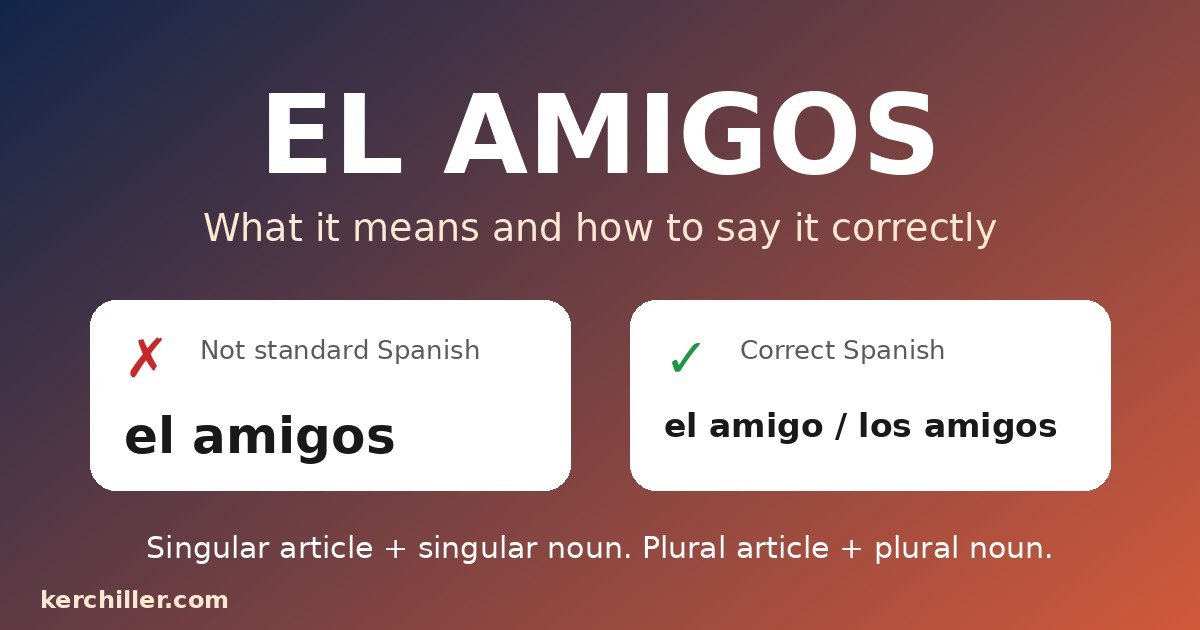
You have probably seen el amigos on a restaurant sign, in a social media caption, or in a search bar, and wondered what it actually means. The short answer is that it points to the Spanish word for friend. The phrase itself, however, is not correct Spanish. “El” is a singular masculine article, while “amigos” is a plural noun, so the two words do not match.
A Spanish speaker would say el amigo for one male friend or los amigos for a group of friends. That small mismatch is exactly why so many people search for the phrase. In this guide, you will learn what el amigos means, how to correct it, where the word appears in pop culture, and how to use it naturally in everyday sentences.
What Does “El Amigos” Mean?
Taken literally, el amigos combines el, which means “the,” with amigos, which means “friends.” Read quickly, it looks like “the friends.” The trouble is that Spanish requires articles and nouns to agree in both gender and number. Because el is singular and amigos is plural, the pairing does not work in standard Spanish.
The root word is amigo, which means “friend.” It is a flexible noun that can describe a man or a woman. A male friend is el amigo, a female friend is la amiga, and a group of friends is los amigos. A group made up only of women is las amigas.
When someone types el amigos into a search engine, they are usually after one of three things: the meaning of the word, the correct way to write it, or a business, song, or movie that uses the name.
How to Say It Correctly in Spanish
The fix is simple once you know the rule. The article and the noun must match in number. Use a singular article with a singular noun, and a plural article with a plural noun.
| English | Correct Spanish | Form |
|---|---|---|
| the friend (male) | el amigo | singular, masculine |
| the friend (female) | la amiga | singular, feminine |
| the friends (male or mixed group) | los amigos | plural, masculine |
| the friends (all female) | las amigas | plural, feminine |
Here are two quick examples that show the difference:
- El amigo de Carlos vive en Madrid. (Carlos’s friend lives in Madrid.)
- Los amigos de Carlos viven en Madrid. (Carlos’s friends live in Madrid.)
Notice that the verb also changes from vive to viven when the subject becomes plural. Getting the article right is the first step, and the rest of the sentence follows from it.
Why English Speakers Often Write “El Amigos”
English makes this mistake easy. The word “the” never changes, so “the friend” and “the friends” use the same article. Spanish does not work that way. Every article has to change to match the noun that follows it.
Learners also tend to treat a phrase as one fixed block. If you hear los amigos often, it is natural to remember “amigos” as the main word and then attach the wrong article from memory. Typing quickly, or searching without checking the spelling, produces the same result. This is a normal stage of learning the language, not a sign that you are doing something badly.
Amigo Beyond the Dictionary Definition
The word amigo is more flexible than a plain translation of “friend.” According to SpanishDict, it can also mean pal, buddy, or mate, depending on the region. Speakers in the United States are more likely to say “buddy,” while speakers in the United Kingdom lean toward “mate.”
A few related phrases are worth knowing:
- Un amigo mío means “a friend of mine.”
- Mejor amigo means “best friend” (use mejor amiga for a woman).
- Amigos can also work as an adjective, as in países amigos, which means “friendly countries.”
Tone matters as well. Calling someone amigo in a warm, casual setting sounds friendly. In other settings, it can sound distant or even a little sarcastic, so listen to how locals use it before adopting it yourself.
El Amigos in Pop Culture
The word amigos reached a huge English-speaking audience through film. ¡Three Amigos! is a 1986 American Western comedy directed by John Landis and written by Steve Martin, Lorne Michaels, and Randy Newman. Martin, Chevy Chase, and Martin Short play three silent film stars who are mistaken for real heroes by a small Mexican village. The movie was released on December 12, 1986, and grossed about $39.2 million in the United States. Randy Newman wrote its songs, and Elmer Bernstein composed the score. Its working title was Three Caballeros, a nod to the 1944 Disney film of the same name.
The phrase “Three Amigos” has since taken on other meanings. Wikipedia’s disambiguation page lists the “Three Amigos Summit,” a nickname for the North American Leaders’ Summit, which brings together the leaders of Canada, Mexico, and the United States. It also notes a “Three Amigos” workshop used in behavior-driven software development. In each case, the idea is a small trio of partners working closely together.
Why Do People Still Use “El Amigos”?
Even though the grammar is off, you will see the phrase in several places. Small businesses often pick a name with amigos in it because it sounds friendly and signals a Latin flavor, and some choose unusual spellings to make the name memorable or simply by accident. Social media captions and usernames also tend to bend grammar rules for style.
Search behavior plays a part too. People type short phrases and let Google sort out the spelling, so el amigos gets entered into search bars even though it is not standard Spanish. Understanding why a phrase spreads online is part of reading the web well, and our look at what’s trending right now shows how everyday words and topics rise and fade in search interest.
How to Use Amigo Correctly in Everyday Sentences
Once you have the rule, the word becomes easy to use. Try these examples:
- Mi amigo viene a cenar esta noche. (My friend is coming to dinner tonight.)
- Mis amigos son muy divertidos. (My friends are very funny.)
- Ella es una buena amiga. (She is a good friend.)
- Hola, amigos. (Hello, friends.)
- Gracias, amigo. (Thanks, my friend.)
A simple habit helps: before you write a Spanish noun, decide whether you mean one or many, and then pick the matching article. If you are naming a business or a project, run the name past a native speaker so the final spelling feels natural.
Frequently Asked Questions
What does el amigos mean in English?
Literally, it reads as “the friends,” but the phrase is not correct Spanish. The correct options are el amigo (“the friend”) and los amigos (“the friends”).
Is “el amigos” correct Spanish?
No. “El” is singular and “amigos” is plural, so they do not agree. Use el amigo for one male friend or los amigos for several friends.
What is the plural of el amigo?
The plural is los amigos. For an all-female group, use las amigas.
How do you say “my friends” in Spanish?
Say mis amigos for male or mixed groups and mis amigas for all-female groups.
What is the difference between amigo and amiga?
Amigo refers to a male friend, and amiga refers to a female friend. In a mixed group, Spanish uses the masculine plural amigos.
Who are the Three Amigos?
In the 1986 film, they are Lucky Day, Dusty Bottoms, and Ned Nederlander, three silent film actors played by Steve Martin, Chevy Chase, and Martin Short. A small Mexican village mistakes them for real heroes.
Conclusion
El amigos is best understood as a common slip rather than a real Spanish phrase. The idea behind it is clear, since amigo means friend, but correct Spanish needs the article and the noun to match: el amigo for one friend and los amigos for many. Once you remember that rule, you can read signs, write captions, and chat with Spanish speakers with more confidence.
If you enjoy decoding meanings like this, you may also like our complete dream meaning guide, which explains what your dreams may be telling you.