
Bereavement Leave: The Complete Guide for Employees and Employers (2026)
Introduction: Grief in the Workplace
Losing someone you love is one of the most difficult experiences a person can face. Yet within days — sometimes hours — of receiving devastating news, millions of American workers must think about calling their employer, filling out paperwork, and figuring out how many days off they are entitled to.
The reality of bereavement leave in the United States in 2026 is a complicated one. Unlike many other developed nations that have established national standards for grief-related time off, the United States still has no federal law requiring private employers to offer bereavement leave. Instead, a patchwork of state laws, employer policies, and union agreements determines how much — if any — protected time off a grieving worker receives.
This guide covers everything you need to know: what bereavement leave is, which states require it, how many days are standard, how FMLA interacts with bereavement, and how employers can build compassionate, legally compliant policies.
What Is Bereavement Leave? Definition and Purpose
Bereavement leave is a specific category of workplace leave designed to give employees time away from work after the death of someone close to them. The purpose is straightforward: to allow the employee to grieve, attend funeral or memorial services, handle estate and legal matters, and begin the process of emotional recovery before returning to work.
It is important to understand that bereavement leave is distinct from other types of leave:
Bereavement leave vs. PTO: Paid time off (PTO) is general time off that employees can use for any purpose — vacation, illness, personal errands, or rest. Bereavement leave is specifically triggered by a death and may be provided in addition to an employee’s PTO balance.
Bereavement leave vs. FMLA: The Family and Medical Leave Act (FMLA) provides up to 12 weeks of unpaid, job-protected leave for serious health conditions, caring for a family member with a serious condition, or bonding with a new child. FMLA does not directly cover bereavement, though it may apply indirectly if grief leads to a diagnosed serious health condition like clinical depression or an anxiety disorder.
Bereavement leave vs. compassionate leave: These terms are often used interchangeably in the United States. In some countries, compassionate leave is broader and can cover family emergencies or serious illness of a loved one, not just death.
Federal Bereavement Leave Law in 2026: What You Need to Know
The most important fact about bereavement leave at the federal level is this: there is no federal law requiring private-sector employers in the United States to provide it.
The Fair Labor Standards Act (FLSA), which governs minimum wage and overtime rules, does not address bereavement leave. The Family and Medical Leave Act (FMLA) does not provide bereavement leave either, even when a family member dies. As of July 2026, Congress has not passed any law establishing a universal right to time off when someone close to you dies.
There are limited exceptions for federal government employees. The Federal Employees Family Friendly Leave Act provides some protections for the federal workforce. Additionally, federal employees whose family member dies as a result of active military service in a combat zone may receive up to three days of paid funeral leave — but this benefit is specific to that circumstance and does not apply to private-sector workers.
For the vast majority of American workers, the right to bereavement leave depends entirely on three things: the state you work in, your employer’s written policy, and any applicable collective bargaining agreement.
State Bereavement Leave Laws: Which States Require It?
The number of states with mandatory bereavement leave laws has been growing steadily, and 2026 has brought meaningful updates. Here is the current state-by-state picture:
States with Dedicated Bereavement Leave Laws
California California was among the first states to establish a clear bereavement leave requirement. Employers with five or more employees must provide bereavement leave, and employees must have worked at least 30 days before the leave begins. California allows up to five days of leave, which may be unpaid. The state’s law is notable for its relatively broad definition of qualifying relationships.
Illinois Illinois requires employers to provide bereavement leave to eligible employees. The leave covers a range of family relationships and is designed to give workers time for funeral attendance, grief, and related tasks following a death.
Maryland Maryland’s approach is tied to its existing paid leave framework. Employees in Maryland can use their accrued earned paid leave for bereavement purposes when an immediate family member dies. This effectively converts existing paid sick or vacation time into protected bereavement leave rather than creating a separate standalone entitlement.
Oregon Oregon has one of the more comprehensive bereavement leave frameworks in the country. Its bereavement leave law, which took effect as part of Oregon Revised Statutes Chapter 659A, requires employers to provide job-protected leave for qualifying deaths. Companies in Oregon typically offer between three and ten days depending on their specific policies and the relationship involved.
Vermont Vermont mandates bereavement leave for eligible employees, adding to the state’s reputation for strong worker protections. Like most state laws, Vermont’s requirement focuses on providing minimum protections that employers can choose to exceed.
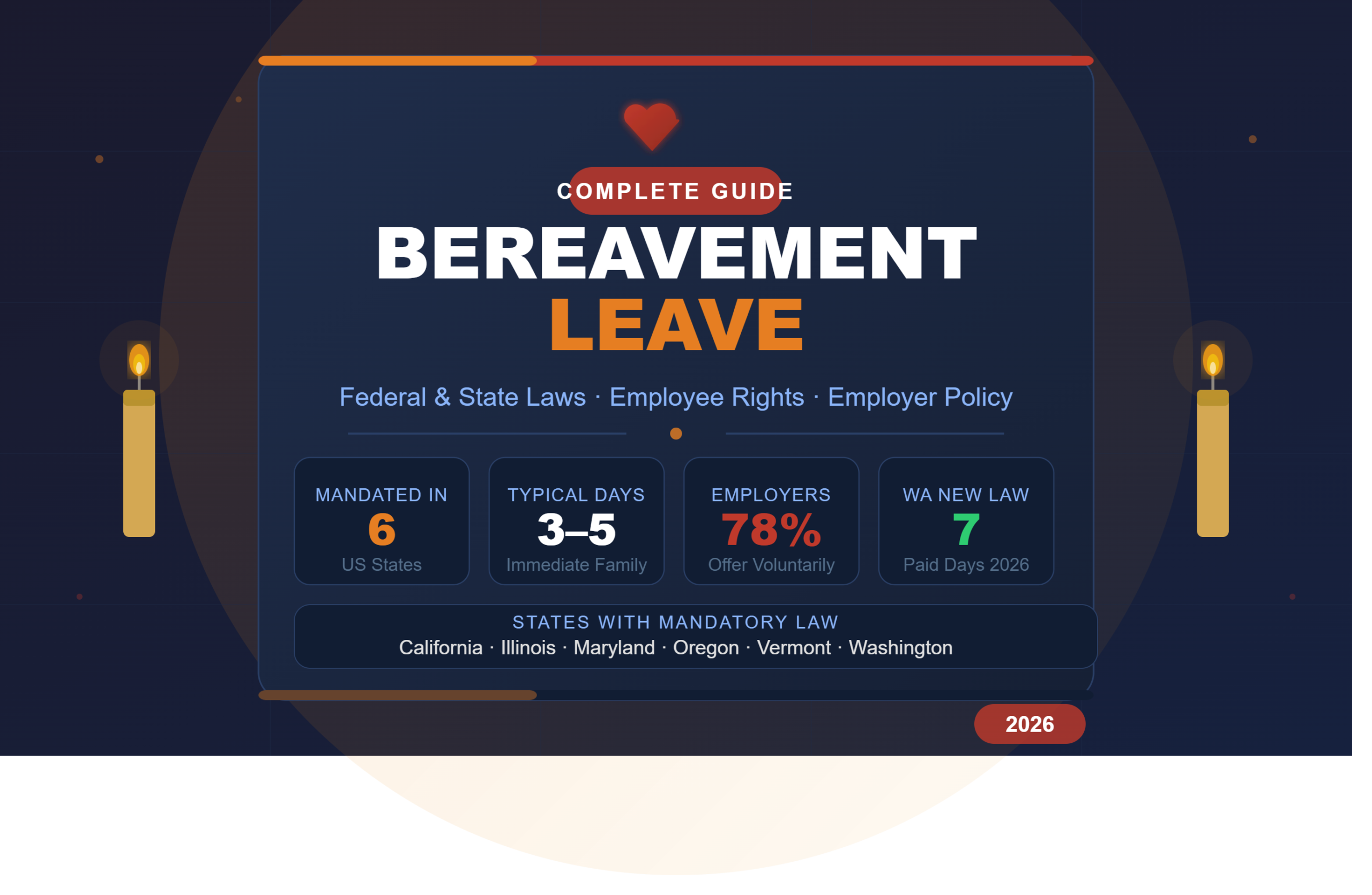
Washington Washington is the only state in the United States that currently mandates paid bereavement leave as a standalone benefit. Eligible employees can use paid family leave for bereavement following the death of a qualifying family member. In a significant expansion that took effect on July 1, 2026, Senate Bill 5217 increased Washington’s paid bereavement leave from three days to seven paid days, usable within 12 months of a qualifying family member’s death.
States with Bereavement Coverage Through Broader Leave Laws
Colorado Colorado does not have a standalone bereavement leave law, but the Colorado Healthy Families and Workplaces Act allows employees to use accrued paid sick leave for bereavement-related needs. This provision has been in effect since August 2023 and gives workers flexibility to use their sick leave balance for funeral attendance, grief, and related activities.
Minnesota Minnesota offers two avenues for bereavement-related leave coverage. First, its Earned Sick and Safe Time (ESST) law, in effect since January 2024, allows employees to use accrued paid time off for funeral arrangements, memorial services, and matters related to a family member’s death. Second, Minnesota’s Paid Family and Medical Leave (PFML) program launched in January 2026, providing wage replacement benefits that may support employees during bereavement periods in certain qualifying circumstances.
States Without Mandatory Bereavement Leave
The remaining 44 states have no dedicated bereavement leave law. In these states, whether an employee receives any bereavement leave — and how much — depends entirely on their employer’s voluntary policy. This does not mean employees in these states are necessarily without support; most major employers provide bereavement leave regardless of legal requirement. But it does mean there is no floor, no minimum, and no job protection guaranteed by law.
How Many Days of Bereavement Leave Is Standard?
Even where no legal requirement exists, most U.S. employers offer some form of bereavement leave. The Society for Human Resource Management (SHRM) has reported that roughly 90% of organizations offered bereavement leave as of recent surveys, and approximately 78% of employers provide some form of bereavement time, though only about 40% make it paid.
The typical structure of employer bereavement policies looks like this:
Immediate family (spouse, child, parent): Three to five days is the most common range. Many large employers — particularly in technology, finance, and professional services — now offer five days as a baseline. Some companies, following high-profile public advocacy around grief in the workplace, have expanded this to ten or more days, particularly for the loss of a child or spouse.
Extended family (grandparent, sibling, in-law): Most policies provide one to three days for extended family members.
More distant relatives or non-family: Many employers provide one day, or require the employee to use PTO for any additional time needed.
The three-day standard that remains common at many companies is not based on any legal requirement or scientific understanding of grief. It comes from longstanding employer practice predating most state laws. It reflects the time typically needed between a death and a funeral — but as grief counselors and mental health professionals consistently point out, the process of grief extends far beyond the funeral itself.
Bereavement Leave and FMLA: How They Interact
Even though FMLA does not directly provide bereavement leave, it can intersect with a loss in important ways.
If grief following a death leads to a clinically diagnosed serious health condition — such as major depressive disorder, complicated grief disorder, or a severe anxiety condition — an employee may qualify for FMLA leave based on that health condition. To use FMLA in this context, the employee must work for an employer with 50 or more employees, have worked there for at least 12 months, and have logged at least 1,250 hours in the previous year.
Additionally, FMLA can be used before a death occurs — for example, to care for a family member who is seriously ill and near the end of life.
For workers in states with active Paid Family and Medical Leave (PFML) programs, there may be additional wage replacement benefits available during bereavement or grief-related health conditions. As of 2026, states with active PFML programs include California, Colorado, Connecticut, Delaware, Maine, Maryland, Massachusetts, Minnesota, New Jersey, New York, Oregon, Rhode Island, Vermont, Washington, and the District of Columbia.
Who Counts as a Qualifying Family Member?
One of the most significant variables in any bereavement leave policy — whether mandated by state law or established voluntarily by an employer — is the definition of “family member.” This definition determines who a worker can take bereavement leave for, and the variation is significant.
At the narrow end, some policies limit bereavement leave to immediate family: spouse or domestic partner, children, and parents. At the broader end, policies may include:
- Grandparents and grandchildren
- Siblings
- In-laws (parents-in-law, siblings-in-law)
- Stepparents and stepchildren
- Domestic partners not legally married
- Foster children and foster parents
- Close friends or chosen family
- Miscarriage, stillbirth, or infant death (increasingly recognized under newer state laws)
The trend in 2026 is toward broadening the definition. Several states are considering or have recently passed legislation that expands coverage to reproductive loss events — including miscarriage, failed adoption, and stillbirth — recognizing that the grief associated with these losses is equally valid and equally deserving of workplace support.
How to Request Bereavement Leave
If you need to take bereavement leave, here is a practical step-by-step approach:
Step 1: Check your employee handbook. Your employer’s bereavement leave policy should be documented in the employee handbook. Look for the number of days provided, which relationships qualify, whether the leave is paid or unpaid, and whether documentation is required.
Step 2: Notify your manager or HR promptly. As soon as you are able, inform your manager or HR department that you need bereavement leave. You do not need to provide extensive detail — a simple notification that you have experienced a loss and need time off is sufficient.
Step 3: Understand documentation requirements. Some employers require documentation such as a death certificate, funeral program, or obituary notice. If your employer requests this, they should ask sensitively and allow you to provide it after your return rather than before your leave begins.
Step 4: Know your state rights. If you work in California, Illinois, Maryland, Oregon, Vermont, Washington, Colorado, or Minnesota, you have specific legal protections. Familiarize yourself with your state’s requirements so you know the minimum leave you are entitled to regardless of your employer’s policy.
Step 5: Consider additional options if needed. If the bereavement leave your employer provides is insufficient for your needs, consider using accrued PTO, FMLA if applicable, or speaking with HR about flexible arrangements for your return.
How Employers Can Build a Compassionate Bereavement Policy
For employers, bereavement leave is both a legal compliance matter and a fundamental expression of workplace culture. A well-designed policy does more than meet minimum legal requirements — it communicates to employees that the organization values them as human beings, not just as workers.
Here are the key elements of a compassionate, effective bereavement leave policy:
Be generous with time. The three-day standard is increasingly recognized as insufficient for meaningful grief. Consider offering five days for immediate family as a baseline, with additional flexibility for close relationships or complicated circumstances like travel requirements or multiple losses.
Broaden your definition of family. Consider including domestic partners, chosen family, close friends, foster children and parents, and miscarriage or pregnancy loss. Grief does not follow a narrow legal definition of family.
Make leave paid. Unpaid leave forces employees to choose between grieving and their paycheck. Paid bereavement leave removes a financial burden from an already devastating time and demonstrates genuine organizational commitment to employee wellbeing.
Train managers. Managers are usually the first point of contact for an employee dealing with a loss. Train them to respond with sensitivity, avoid demanding documentation during the most acute period of grief, and check in with employees on their return.
Offer additional support. Bereavement leave is just the beginning. Complementary support structures — employee assistance programs (EAPs), access to grief counseling, flexible scheduling on return, and mental health resources — make a meaningful difference in how employees experience and recover from loss.
Review the policy regularly. State bereavement leave laws are changing rapidly. Review your policy at least annually to ensure compliance with any new state requirements in the jurisdictions where your employees work.
The Emotional Reality: Why Bereavement Policy Matters
Behind every bereavement leave request is a person in real pain. Certified grief counselor Kelly Edmondson, founder of Timely Presence, has noted that “how long a person grieves is determined by company policy, not the magnitude of their loss.” This observation captures something important: the institutional response to grief shapes the experience of grieving.
Employees who feel genuinely supported during bereavement return to work with stronger loyalty, greater engagement, and more resilience. Those who feel rushed back, unsupported, or forced to use vacation days for grief return distracted, depleted, and resentful.
For organizations focused on retention and culture, a compassionate bereavement policy is not a soft benefit — it is a strategic investment.
Summary: Key Bereavement Leave Facts for 2026
- No federal law requires private-sector bereavement leave
- Six states mandate it: California, Illinois, Maryland, Oregon, Vermont, Washington
- Colorado and Minnesota cover bereavement through broader sick/paid leave laws
- Washington expanded paid bereavement leave to 7 days effective July 1, 2026
- Typical employer policy: 3–5 days for immediate family, 1–3 days for extended family
- Only about 40% of employers make bereavement leave paid
- FMLA may apply if grief causes a serious diagnosed health condition
- The trend is toward broader definitions of family and expanded coverage for reproductive loss
Frequently Asked Questions About Bereavement Leave
Is bereavement leave required by federal law? No. There is no federal law requiring private-sector employers in the United States to provide bereavement leave. The FLSA and FMLA do not mandate it.
Which states require bereavement leave? As of 2026, six states have dedicated bereavement leave laws: California, Illinois, Maryland, Oregon, Vermont, and Washington. Colorado and Minnesota offer bereavement coverage through broader paid sick leave programs.
How many days of bereavement leave am I entitled to? It depends on your state and employer. In states without a law, your employer’s policy determines the amount. Where laws exist, they typically provide three to five days for immediate family. Washington now provides seven paid days effective July 1, 2026.
Is bereavement leave paid or unpaid? Most state bereavement leave laws allow the leave to be unpaid. Only Washington mandates paid bereavement leave as a standalone benefit. Whether your leave is paid depends on your state law and your employer’s policy.
Can I use FMLA for bereavement? Not directly. FMLA does not provide bereavement leave. However, if grief leads to a clinically diagnosed serious health condition, FMLA may apply for that condition.
Does bereavement leave apply to miscarriage or pregnancy loss? This is an evolving area. Some states are expanding their bereavement leave laws to include reproductive loss events. Check your specific state law and employer policy.
What if my employer denies my bereavement leave request? If you are in a state with a mandatory bereavement leave law and your employer denies a qualifying request, you may file a complaint with your state’s labor department. In states without a law, your options depend on your employer’s written policy.
Can my employer require documentation for bereavement leave? Yes, many employers do require documentation such as a death certificate, funeral program, or obituary. However, best practice is to request this sensitively and allow employees to provide it after their return.