
What Is Minimum Wage in Florida? Complete Guide for 2026
Introduction: Florida’s Path to $15 Per Hour
Florida’s minimum wage story in 2026 is not just about a number — it is about a promise made by the people of Florida to their workers.
In November 2020, Florida voters approved Amendment 2, a constitutional amendment that set Florida on a clear path: increase the state minimum wage by $1.00 every year until it reaches $15.00 per hour by September 30, 2026. That vote passed with over 60 percent support, making it one of the strongest mandates for wage increases in Florida history.
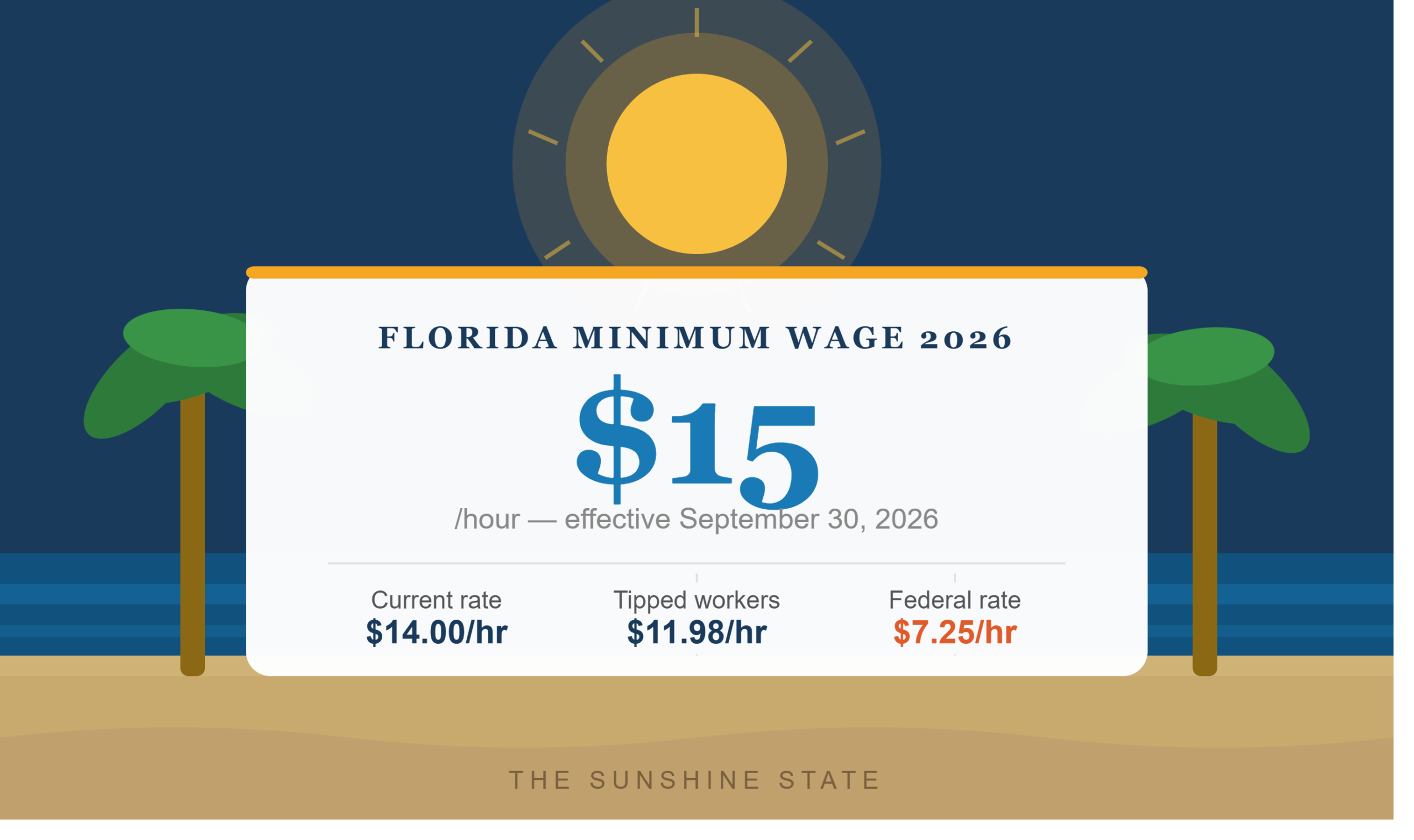
Today, that promise is nearly fulfilled. As of September 30, 2025, Florida’s minimum wage stands at $14.00 per hour. In just a matter of months — on September 30, 2026 — it will reach the long-anticipated target of $15.00 per hour, completing a six-year journey that began from a base of $8.65 in 2021.
This is not just a financial milestone. It is a legal and operational turning point for every employer in Florida and a critical rights update for every worker earning hourly wages in the state.
Florida Minimum Wage 2026: Current Rates at a Glance
Here is a clear breakdown of all current and upcoming wage rates in Florida:
Standard (Non-Tipped) Employees
| Period | Minimum Wage |
|---|---|
| September 30, 2025 – September 29, 2026 | $14.00 per hour |
| September 30, 2026 onwards | $15.00 per hour |
Tipped Employees
| Period | Cash Wage | Tip Credit | Total Must Equal |
|---|---|---|---|
| Through September 29, 2026 | $10.98/hr | $3.02/hr | $14.00/hr |
| From September 30, 2026 | $11.98/hr | $3.02/hr | $15.00/hr |
Important: If a tipped employee’s cash wages plus tips do not add up to the full Florida minimum wage, the employer is legally required to make up the difference. There are no exceptions to this rule.
Federal vs. Florida Minimum Wage
The federal minimum wage has remained at $7.25 per hour since 2009 — unchanged for over 15 years. Florida’s current rate of $14.00 per hour is nearly double the federal floor, and when Florida’s rate reaches $15.00 on September 30, 2026, it will be $7.75 higher than the federal standard. When state and federal rates differ, workers are entitled to whichever rate is higher — which means virtually all Florida employees receive the state rate.
Read More: Diag Image: Transforming Healthcare Diagnosis
The History Behind Florida’s Minimum Wage Increases
Understanding where Florida’s minimum wage is today requires looking at how it got here.
Florida first established its own minimum wage in 2004 through a voter-approved constitutional amendment. For many years, the rate increased gradually tied to inflation — a slow, steady process that kept wages roughly in line with the cost of living but never dramatically raised the floor.
Then came November 2020. Florida voters approved Amendment 2 with a clear majority, setting a structured schedule of $1.00 annual increases starting in 2021. Here is how that schedule played out:
| Effective Date | Minimum Wage |
|---|---|
| January 1, 2021 | $8.65/hr |
| September 30, 2021 | $10.00/hr |
| September 30, 2022 | $11.00/hr |
| September 30, 2023 | $12.00/hr |
| September 30, 2024 | $13.00/hr |
| September 30, 2025 | $14.00/hr |
| September 30, 2026 | $15.00/hr |
After 2026, Florida’s minimum wage will no longer follow a fixed schedule. Instead, it will be adjusted annually for inflation based on the Consumer Price Index (CPI), with the Florida Department of Commerce announcing the new rate by October 15 each year, effective January 1 of the following year.
This means $15.00 is not the ceiling — it is the new floor from which future inflation-adjusted increases will grow.
Tipped Employees: How Florida’s Minimum Wage Works for Servers and Bartenders
If you work in a restaurant, bar, hotel, or any service industry where tips are a regular part of your compensation, the rules are slightly different — but your rights are just as strong.
The Tip Credit System
Florida law allows employers to pay tipped employees a reduced direct cash wage using what is called a tip credit. Here is how it works:
The tip credit in Florida is fixed at $3.02 per hour, a figure set by the 2003 Fair Labor Standards Act and unchanged since then. This means:
- Employer pays direct cash wage of $10.98 per hour (currently)
- Tips received by the employee cover the remaining $3.02 per hour
- Combined total must equal at least $14.00 per hour (the full minimum wage)
Starting September 30, 2026:
- Employer pays direct cash wage of $11.98 per hour
- Tips cover the $3.02 gap
- Combined total must equal at least $15.00 per hour
What Happens If Tips Are Not Enough?
If an employee does not receive enough tips in a given pay period to bring their total hourly compensation to the full minimum wage, the employer must pay the difference out of pocket. This is a non-negotiable legal requirement.
Tip Pooling Rules
Florida law permits tip pooling among employees, but with clear boundaries. The following employees can participate in a tip pool: servers, bartenders, bussers, hosts, and other customer-facing staff who regularly receive tips. The following cannot participate: managers, supervisors, owners, and back-of-house staff like cooks who do not regularly receive tips from customers.
An employer who forces tipped employees to share tips with non-tipped staff or management may be violating Florida wage law.
Who Is Covered by Florida’s Minimum Wage Law?
Florida’s minimum wage applies to most workers in the state. Specifically, it covers all employees who are entitled to minimum wage under the federal Fair Labor Standards Act (FLSA), which includes most full-time, part-time, and temporary workers at businesses engaged in interstate commerce or with annual revenues above $500,000.
Exemptions and Special Cases
While most Florida workers receive full minimum wage protection, several categories have different rules:
Small Businesses: Businesses with less than $110,000 in annual revenue that do not engage in interstate commerce may be eligible to pay a reduced rate of $4.00 per hour under federal law. However, this exemption is narrow and does not apply to most Florida employers.
Agricultural Workers: Seasonal and agricultural workers may be paid the federal minimum wage of $7.25 per hour rather than the Florida state rate, reflecting the seasonal nature of agricultural employment.
State and Local Government Employees: Wages for Florida state and local government employees are determined by collective bargaining agreements and may differ from the standard minimum wage.
Student Learners: Students enrolled in vocational education programs may, in some circumstances, be paid a minimum of $4.25 per hour under special certificates issued by the U.S. Department of Labor.
Young Workers: Unlike some states, Florida does not have a separate lower minimum wage for workers under 18 years of age. All employees, regardless of age, are entitled to the full Florida minimum wage.
Salaried Exempt Employees: Executive, administrative, and professional employees who meet the salary basis test and duties requirements under the FLSA are generally exempt from minimum wage requirements. This typically applies to workers earning a salary of at least $684 per week who perform primarily managerial, administrative, or professional duties.
Read More: Reaper Scans: Powerful Boost Or Hidden Problem? Unlock The Secrets To Efficient Audio Production
City-Specific Minimum Wages in Florida: Is There a Higher Rate in Miami or Orlando?
This is one of the most commonly searched questions about Florida’s minimum wage — and the answer is straightforward.
Florida does not allow cities or counties to set their own minimum wage rates. State law preempts local wage ordinances, meaning there is no separate minimum wage for Miami, Orlando, Tampa, Jacksonville, Fort Lauderdale, Pensacola, Sarasota, or any other Florida city.
Whether you work in a beachfront Miami hotel, an Orlando theme park, or a small business in Pensacola, the same statewide minimum wage applies to you. If you are searching for “minimum wage in Orlando” or “minimum wage in Miami,” the answer is the Florida state rate: currently $14.00 per hour, rising to $15.00 on September 30, 2026.
Overtime Rules for Florida Workers
Florida follows the federal overtime rules established by the Fair Labor Standards Act. If you work more than 40 hours in a single workweek, your employer is required to pay you at least 1.5 times your regular hourly rate for every hour beyond 40.
For example:
- If you earn $14.00 per hour (the current minimum wage), your overtime rate must be at least $21.00 per hour
- Starting September 30, 2026, a minimum wage worker earning $15.00 per hour must be paid at least $22.50 per hour for overtime
Florida does not require daily overtime pay — only weekly overtime for hours beyond 40 in a workweek.
Employer Compliance Requirements
If you are an employer in Florida, staying compliant with minimum wage law involves more than simply paying the correct rate. Here are the key requirements:
Mandatory Wage Posting
Under Florida Statute 448.109, all employers must display the official Florida minimum wage poster in a conspicuous and accessible location where all employees can easily see it. This poster must show the current wage rates, employee rights, and contact information for filing complaints.
The Florida Department of Commerce updates and publishes this poster annually in English, Spanish, and Creole. Failure to display the current poster can result in penalties. The poster is available for free download from the Florida Department of Commerce website.
Payroll Record Keeping
Employers must maintain accurate payroll records documenting hours worked, wages paid, and tip records for tipped employees. These records must be available for inspection if a wage complaint is filed.
Scheduled Rate Updates
Employers must update their payroll systems and wage rates on September 30, 2026, when the new $15.00 rate takes effect. After 2026, rate changes will be effective January 1 of each year.
What To Do If You Are Being Paid Less Than Florida Minimum Wage
If you believe your employer is paying you less than the required Florida minimum wage, you have rights — and several options for action.
Step 1: Document Everything
Gather your pay stubs, timesheets, tip records, and any written communications about your wages. Compare your actual pay rate to the correct Florida minimum wage for every pay period. Keep in mind that the applicable rate depends on when the work was performed — the pre-September 30, 2026 rate ($14.00) applies to work done before that date, and the new $15.00 rate applies to work done on or after September 30, 2026.
Step 2: Review Your Hours
Check that your paycheck reflects all hours worked, including time spent opening or closing the business, attending required meetings, completing mandatory training, or doing any work before or after your scheduled shift.
Step 3: File a Complaint
Unlike some states, Florida does not have a separate state wage enforcement agency. Minimum wage complaints in Florida are handled by the U.S. Department of Labor Wage and Hour Division (WHD). You can file a complaint online at dol.gov or by calling your local WHD office.
You can also file a private civil lawsuit against your employer. Florida law allows workers to recover unpaid wages, liquidated damages (which can double your unpaid wage recovery), and reasonable attorney fees if you prevail.
Step 4: Consult an Employment Attorney
If your employer refuses to correct the issue, retaliates against you for asking about wages, reduces your hours, or threatens your job after you raise concerns about minimum wage compliance, consider consulting an employment attorney. Many wage and hour attorneys in Florida offer free initial consultations, and you may be able to recover more than just the unpaid wages themselves.
The Future of Florida’s Minimum Wage After 2026
With the $15.00 milestone arriving on September 30, 2026, many workers and employers are asking: what comes next?
After 2026, Florida’s minimum wage will be tied to the Consumer Price Index (CPI) for urban wage earners and clerical workers in the South region. This means:
- The Florida Department of Commerce will calculate any required increase each year
- The new rate will be announced by October 15 of each year
- The increase (if any) will take effect on January 1 of the following year
- If the CPI shows no inflation or deflation, the minimum wage will remain the same
This inflation-adjustment system ensures that Florida’s minimum wage maintains its purchasing power over time rather than slowly being eroded by rising costs of living between legislative updates.
Legislators are also continuing to debate related issues. During the 2026 legislative session, House Bill 221 proposed allowing employees to voluntarily opt out of the state minimum wage during internships, pre-apprenticeships, or on-the-job training periods. Whether such proposals advance through the legislature remains to be seen.
How Florida Compares to Other States
Florida’s journey to $15.00 per hour places it in good company among states that have made meaningful commitments to raising the wage floor.
Florida’s current $14.00 rate is significantly higher than neighboring states Georgia, South Carolina, Tennessee, and Kentucky — all of which pay only the federal minimum of $7.25 per hour. When Florida reaches $15.00 in September 2026, the difference will be even more stark.
At the same time, Florida’s rate remains below Washington D.C. at $17.50 per hour and some West Coast states that have implemented higher minimum wages through separate legislation.
What distinguishes Florida’s approach is that its minimum wage increase was approved directly by voters through a constitutional amendment — making it more durable and harder to roll back than increases passed through the regular legislative process.
Summary: Key Florida Minimum Wage Facts for 2026
- Current rate: $14.00/hr (through September 29, 2026)
- New rate: $15.00/hr (effective September 30, 2026)
- Tipped cash wage now: $10.98/hr + tips must reach $14.00
- Tipped cash wage from Sept 30: $11.98/hr + tips must reach $15.00
- Federal rate: $7.25/hr — Florida rate always applies when higher
- No city-specific rates: Same rate applies statewide in all Florida cities
- No youth minimum wage: Workers under 18 receive the same full rate
- Overtime: 1.5x regular rate for hours over 40 per workweek
- After 2026: Annual CPI-based adjustments effective January 1 each year
Frequently Asked Questions
What is the minimum wage in Florida in 2026? Florida’s minimum wage is $14.00 per hour from September 30, 2025 through September 29, 2026. It increases to $15.00 per hour on September 30, 2026.
What is Florida’s minimum wage for tipped employees? Tipped employees must receive a direct cash wage of $10.98 per hour, rising to $11.98 on September 30, 2026. Their tips plus cash wage must always total at least the full Florida minimum wage.
Is Florida’s minimum wage going up in 2026? Yes. Florida’s minimum wage will increase from $14.00 to $15.00 per hour on September 30, 2026, completing the schedule set by the voter-approved Amendment 2 in 2020.
Does Miami or Orlando have a higher minimum wage than the rest of Florida? No. Florida state law prohibits cities and counties from setting their own minimum wage. The statewide rate applies equally in Miami, Orlando, Tampa, Jacksonville, and every other Florida city.
What is the minimum wage in Florida for teenagers? Florida does not have a lower minimum wage for workers under 18. Teenagers receive the same full minimum wage as adult workers.
What happens if my employer pays me less than Florida minimum wage? You can file a complaint with the U.S. Department of Labor Wage and Hour Division, or you may file a private civil lawsuit to recover unpaid wages, damages, and attorney fees.
Will Florida’s minimum wage increase after $15? Yes. After reaching $15.00 in 2026, Florida’s minimum wage will be adjusted annually for inflation based on the Consumer Price Index, with new rates effective January 1 each year.