IDGod is a name that keeps showing up in search results, forums, and social media threads, and it is almost always linked to fake identification cards. If you landed here after seeing the name somewhere, you probably want a straight answer: what is it, is it legit, and is it safe? This guide explains what IDGod refers to, how sites like it work, the scam and legal risks involved, and the safer options you have.
What Is IDGod?
IDGod is the name of an online vendor of counterfeit, “scannable” identification cards. A 2017 investigation by MEL Magazine described it as the biggest online fake ID vendor in the world at the time. The article reported that buyers ordered online from overseas suppliers, paid in hard-to-trace ways, and then waited weeks for an unmarked package.
That is the core of what IDGod means in practice. It is not a government service, not a verification tool, and not a legal way to obtain identification. It is a brand name attached to the sale of forged documents, which is the activity covered by identity document forgery laws in many countries.
It is also worth knowing that the name is now used far beyond the original vendor. Search for it today and you will find look-alike pages, empty profiles, and spammy posts on unrelated websites. Pages like these are a typical sign of SEO spam, so anything using the name should be treated with suspicion.
How IDGod-Style Fake ID Sites Operate
According to MEL Magazine’s reporting, the model followed a predictable pattern:
- Online ordering from overseas vendors. Sellers were anonymous and based in China, so buyers had no real company to hold accountable.
- Untraceable payment. Bitcoin and money transfer services were the common methods, which leaves almost no chance of a refund.
- Typical prices of $100 to $200 per card. Group orders were sometimes used to bring the per-card cost down.
- Slow and unreliable delivery. The author waited nine weeks, and one source’s friend was still waiting after four months.
- Hidden shipping. Packages arrived disguised as something else, which is a clear sign the product is illegal.
Customs data shows the scale. The article cited a US mail official who said that in a single year, 4,585 counterfeit IDs made in China were intercepted at JFK Airport alone, most of them heading to college students. Every one of those buyers had already paid.
Why the Name Keeps Trending
Three things keep this keyword alive. First, age limits create steady demand, especially among teenagers and college students. Second, forum posts and review threads keep recycling the name. Third, scammers create fake “review” pages that rank for the term and push readers toward shady checkout pages. Many people searching for IDGod are really asking a safety question: “Is this real, or will I lose my money?” That is exactly what the rest of this article answers.
The Scam Risks
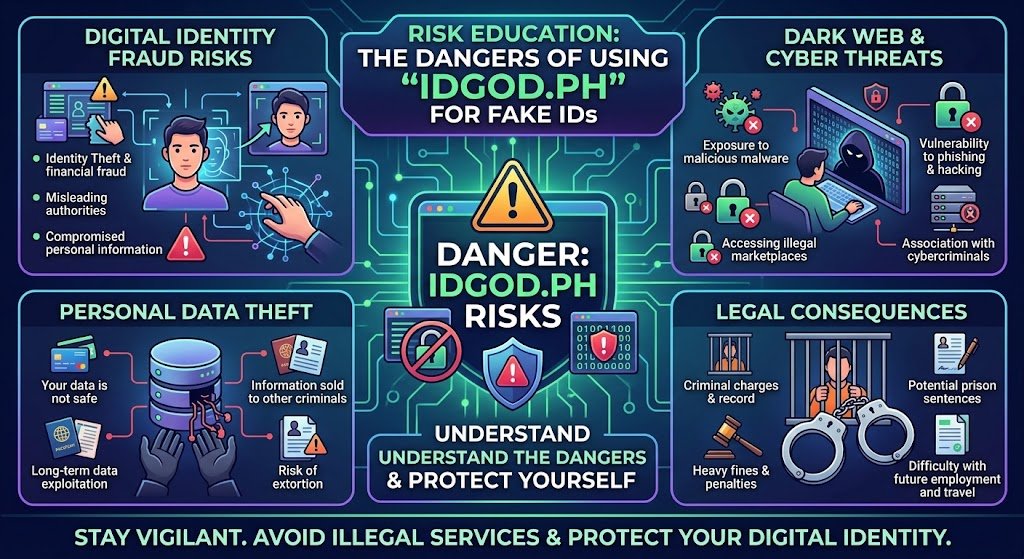
Even setting the law aside, buying from a fake ID site is a bad deal for the buyer. The main risks are:
- You may never receive anything. Anonymous sellers paid with untraceable methods have no reason to deliver, and no one to complain to if they do not.
- Your personal data is exposed. These sites ask for a photo, signature, address, and date of birth. That is everything an identity thief needs. Consumer-safety writers warn that some such sites collect this data for fraud rather than to make a product.
- Your payment details can be abused. Card details entered on an unknown site can be used for later charges.
- Blackmail is possible. A seller holding your name, address, and proof that you ordered an illegal item has leverage over you.
- Clone sites steal first-time buyers. Because the name is widely copied, you often cannot tell whether a site is the “original” or a copycat built only to take payments.
To learn how to judge whether a website deserves your trust, see our guide on whether you should trust a website before you enter any payment or personal details online.
The Legal Consequences
Buying, owning, or using a fake ID is a crime in most places, and the consequences can be serious.
In the United States, federal law (18 U.S.C. § 1028) covers fraud involving identification documents. Under the statute as published by Cornell Law School’s Legal Information Institute:
- Producing or transferring a false identification document can carry up to 15 years in prison when the document is or appears to be issued by the United States, or is a driver’s license or ID card.
- Possessing a false document with intent to use it unlawfully can carry up to 5 years.
- Attempts and conspiracies carry the same penalties as the completed offense.
State laws add their own penalties, which often include fines, license suspension, and a criminal record. Using a fake ID at a bar, airport, or government office can lead to confiscation and charges. Other countries have similar rules.
In practice, most young people caught with a fake ID face state-level consequences rather than federal prison. Still, a record can affect college admissions, scholarships, professional licenses, and job applications for years. For a drink or a club entry, that is a heavy price.
Other Real-World Consequences
The legal side is only part of it. Colleges and employers can take disciplinary action against anyone caught with a fake ID, and confiscation by venue staff is common. Venues are also getting better at checking documents. Staff are trained to inspect security features, and scanning apps can read the barcode on a license and check the data against what is printed on the card. A fake that looks fine to the eye can still fail a check.
How to Protect Yourself
If you came across IDGod through an ad, a message, or a social media post, here is what to do:
- Do not send photos, personal details, or money. Once shared, they cannot be taken back.
- Be sceptical of any “review” site that ranks well for the name. Real businesses do not hide behind cryptocurrency-only payment. Our article on how to verify unfamiliar claims explains a simple method for checking sources.
- Report the site. In the US you can file a report at ReportFraud.ftc.gov. Other countries have equivalent consumer-protection agencies.
- If you already paid, contact your bank or card provider, monitor your accounts, and consider a credit freeze if you shared personal information.
- Never use a fake ID, even if you already own one. Possession is where many cases begin.
Legitimate Alternatives
If your real problem is proof of age or identity, there are legal fixes:
- A government-issued ID. Your local motor vehicle agency can issue a state ID card, often faster than people expect, including replacement cards.
- A passport or passport card. Accepted widely for age and identity checks.
- Mobile or digital IDs. A growing number of regions now offer official digital versions of driver’s licenses.
- Proof-of-age cards. In the UK, for example, PASS-accredited cards are widely accepted for age verification.
Frequently Asked Questions
What is IDGod?
IDGod is the name of an online vendor of counterfeit identification cards. It became well known after press coverage in the 2010s, and the name is now widely copied by look-alike websites.
Is IDGod legit?
No. It is a brand tied to selling illegal documents. Buyers have no legal protection, and delivery, quality, and data safety cannot be trusted.
Is it illegal to buy a fake ID online?
In most jurisdictions, yes. Buying, possessing, or using a fake ID can lead to fines, a criminal record, and in serious cases imprisonment. In the US, federal law can also apply.
Can fake IDs be detected?
Often, yes. Venues check security features and use scanning tools that compare barcode data with the printed details. Border agencies also intercept counterfeit shipments in large numbers.
What should I do if I already gave my details to a fake ID site?
Stop all contact, contact your bank if you paid by card, watch your accounts for unusual activity, change reused passwords, and report the site to your national consumer-protection agency.
Conclusion
IDGod is best understood as a warning, not a service. The name points to an illegal market in counterfeit identification where buyers risk their money, their personal data, and their future. The scams are common, the legal penalties are real, and detection keeps improving.
If you need identification, get it through official channels, which are safe and fully legal. And whenever a site asks for your personal details and promises something that sounds too easy, stop and check it first. A few minutes of caution can save you from a mistake that follows you for years.